Evaluation README
The evaluation module makes recommendation tradeoffs visible through metrics, fixtures, and Pareto-frontier artefacts.
The runnable rep
Section titled “The runnable rep”Rep #7 is a self-contained sweep:
tutorial/evaluation/lesson-01-constraint-sweep.py.
It takes one candidate set with known clicks, ranks it under a sweep of
diversity weights, and reports two metrics at once — accuracy and breadth.
make -C tutorial/evaluation run # print the NDCG-vs-diversity frontiermake -C tutorial/evaluation check # assert the frontier + the checkpointmake -C tutorial/evaluation clean # nothing to clean (pure in-memory)The clicks are concentrated in sport, so the frontier shows the editorial cost of clicks directly:
div_weight top-3 NDCG@3 diversity@3 ---------- ---------- ------- ----------- 0.0 a1 a2 a3 0.765 0.667 <- click-only: most accurate 0.25 a1 a3 a2 0.704 0.667 <- dominated: loses NDCG, no gain 0.5 a1 a3 a5 0.469 1.0 <- full diversity, real cost 1.0 a1 a3 a5 0.469 1.0The checkpoint, worked
Section titled “The checkpoint, worked”Which is the smallest diversity weight that reaches full topic diversity (1.0) at k=3, and what does it cost in NDCG@3?
Weight 0.5, costing NDCG@3 0.765 → 0.469 (a drop of 0.296). Two
lessons hide in the table. First, 0.25 is a dominated point — it sacrifices
accuracy for no diversity gain, so no rational editor would pick it. Second,
there is no “right” answer to the trade: the platform’s job is to make the
frontier visible so the newsroom can choose where on it to sit. That is exactly
the click-cost argument (ADR-0009) made measurable, not the model “being good.”
What makes this a good rep
Section titled “What makes this a good rep”Following the foundations template (ADR-0033): pure functions,
deterministic, no I/O — make run prints the frontier, make check asserts
every cell plus the checkpoint. The grown-up version (below) sweeps a 5×5×5 grid
across three publishers; the rep teaches the shape of the argument first.
Cross-publisher Pareto chart
Section titled “Cross-publisher Pareto chart”The evaluation harness sweeps the soft editorial-control grid as a 5 by 5 by 5 configuration matrix:
diversity_weight:0.00,0.15,0.30,0.60,1.00recency_weight:0.00,0.20,0.40,0.70,1.00sentiment_weight:0.00,0.10,0.20,0.50,1.00
That grid includes the click-only baseline (0, 0, 0) and the platform
default (0.30, 0.40, 0.20). The Dagster asset now runs the same sweep over
the EB-NeRD, Adressa, and MIND holdouts, then materialises
eval_sweep_results with one row per (config, dataset, metric), including
the full configuration columns so analysts can query the same contract from
SQL or notebooks.
The metric set is NDCG@10, MRR, hit-rate@10, intra-list diversity, catalog coverage, median recency, sentiment-distribution divergence, and sensitive-topic exposure.
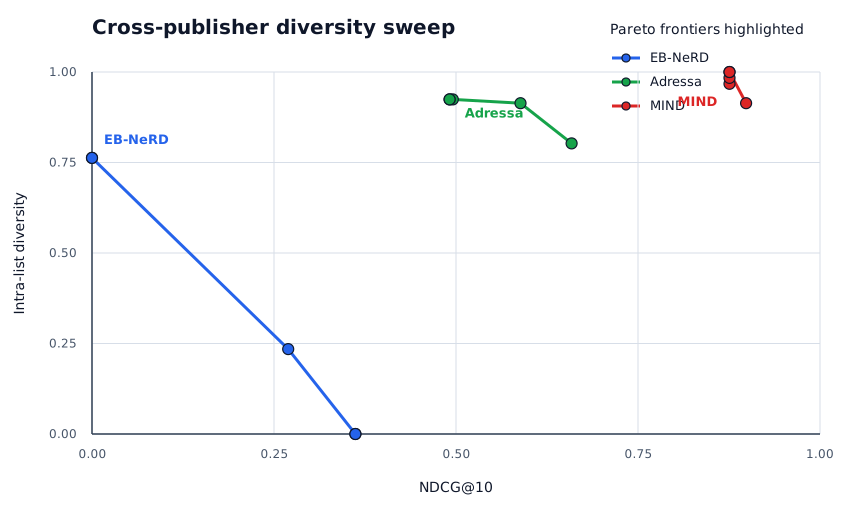
The chart below plots the smaller labelled diversity slice, NDCG@10 against intra-list diversity, with one Pareto frontier per publisher. The same ranking code produces different tradeoff curves because the publisher context changes the candidate shape:
- EB-NeRD is the primary Danish-news substrate. In this holdout it behaves like a deep single-topic session: click accuracy is easiest when the list stays narrow, and diversity has a visible cost.
- Adressa’s local-news fixture has shorter, more mixed local sessions. The curve moves toward higher diversity earlier, which is the cold-start risk in miniature: fewer repeated signals make broad local coverage easier to justify but harder to rank confidently.
- MIND exposes a broader category taxonomy and longer impression slates. Its session-length shape starts more diverse, so the diversity frontier is flatter than EB-NeRD’s.
Deterministic metrics stay in dbt because they are reproducible checks over materialised platform outputs: diversity, recency, source mix, sensitivity exposure, and similar table-shaped facts. Evalite is reserved for editorial assistant behaviour where model text has to be scored: faithfulness, reason validity, changed-constraint coverage, register, and length. See ADR-0020 for the split.